
Laser Cladding vs Hard Chrome Plating: Which Is Better?
If you’re dealing with component wear in mining, aerospace, oil & gas, or manufacturing, you’ve almost certainly used hard chrome plating at some point. For decades, it’s been the go-to for corrosion and wear protection—but the landscape is changing fast.
Regulatory crackdowns on hexavalent chromium, rising disposal costs, and performance limitations are leading more engineering teams to evaluate chrome plating alternatives. Leading the pack is laser cladding technology.
But how does laser cladding vs hard chrome plating really compare? In this guide, we break down performance, cost, environmental impact, durability, and use cases to help you decide which is right for your application.
What Is Hard Chrome Plating?
Hard chrome plating (also called industrial chrome or engineering chrome) is an electroplating process that deposits a thin layer of chromium (typically 0.025-0.5mm thick) onto a metal substrate using an electrolytic bath of chromic acid.
The process has been standard for over 80 years due to its:
- Low material cost for high-volume production
- Good corrosion resistance for mild environments
- Low coefficient of friction for sliding applications
- Ability to plate complex geometries uniformly
However, hard chrome plating has significant drawbacks that have led to increasing regulation across the EU (REACH), US (EPA), and Asia—primarily due to the use of hexavalent chromium (Cr VI), a known carcinogen with severe environmental and occupational health risks.
What Is Laser Cladding?

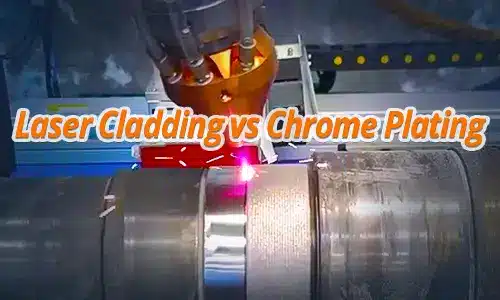
Laser cladding is an advanced surface modification process that uses a focused high-power laser beam to melt and bond metallic powder or wire onto a substrate, creating a true metallurgical bond.
Unlike electroplating which only mechanically adheres to the surface, laser cladding creates a fused, pore-free coating that becomes an integral part of the component. Coating thickness can be precisely controlled from 0.1mm to 5mm+ per layer.
The process uses no hazardous chemicals and produces coatings with dramatically superior wear resistance, bond strength, and durability compared to traditional plating methods.
Looking for a Chrome Plating Alternative?
Chutian Laser engineers can help you evaluate laser cladding as a drop-in replacement for hard chrome in your application. Get a free feasibility assessment and cost comparison.
Laser Cladding vs Hard Chrome Plating: Head-to-Head Comparison
| Factor | Laser Cladding | Hard Chrome Plating |
|---|---|---|
| Bond Type | Metallurgical (fully fused) | Mechanical adhesion only |
| Wear Life (Relative) | 3-10x longer | Baseline (1x) |
| Coating Density | 100% (pore-free) | 95-98% (micro-cracks common) |
| Coating Thickness Range | 0.1mm – 5mm+ per layer | 0.025mm – 0.5mm |
| Hardness | 58-68 HRC (tunable by material) | 60-65 HRC |
| Corrosion Resistance | Excellent (material-dependent) | Good (degrades with micro-cracks) |
| Heat Affected Zone | < 0.5mm (minimal distortion) | None (low temperature process) |
| Delamination Risk | Virtually zero | High under impact/thermal cycling |
| Hazardous Materials | None | Hexavalent chromium (carcinogenic) |
| Regulatory Compliance | No restrictions globally | REACH/EPA restricted, tightening |
| Initial Coating Cost | 1.5-3x higher | Lower upfront |
| Total Cost of Ownership | 30-70% LOWER | Higher (more frequent replacement) |
Detailed Comparison: Key Factors
1. Bond Strength & Durability
This is the single biggest difference between the two processes.
Hard chrome plating only creates a mechanical bond—the chromium sits on top of the surface like paint. Under impact loading, thermal cycling, or high-stress conditions, chrome coatings commonly delaminate (flake off), spall, or crack. Once the coating is breached, corrosion spreads rapidly under the surface.
Laser cladding creates a full metallurgical bond—the coating material actually fuses with the substrate at the molecular level. There is no distinct boundary between coating and base material, meaning delamination is physically impossible. The coating becomes part of the component itself.
Real-world result: In mining bucket tooth applications, chrome-plated teeth typically last 3-6 months. Laser clad carbide teeth last 18-36 months in the same conditions.
2. Wear & Corrosion Performance
Hard chrome provides reasonable wear resistance for light-duty applications, but has inherent limitations:
- Natural micro-cracking from the plating process creates pathways for corrosion
- Cracks propagate under load, accelerating wear
- Limited material options (only chromium)
Laser cladding advantages:
- 100% pore-free, crack-free coatings when properly processed
- Virtually unlimited material options: tungsten carbide, Stellite, Inconel, stainless steel, custom alloys
- Coating material can be precisely matched to the specific wear mechanism (abrasion, erosion, corrosion, heat)
- No micro-crack pathways for corrosion to spread
3. Environmental & Regulatory Impact
This is the fastest-growing pain point for hard chrome users and the #1 reason companies are switching to chrome plating alternatives.
Hard chrome plating risks and regulations:
- Uses hexavalent chromium (Cr VI), a classified human carcinogen
- EU REACH regulation severely restricted Cr VI use as of 2024; authorization required for most applications
- US EPA has tightened exposure limits and waste disposal requirements
- Wastewater treatment and disposal costs have increased 3-5x in the last decade
- Occupational health risks for plating workers require expensive safety systems
- Many large OEMs (Airbus, Boeing, Caterpillar) are requiring suppliers to phase out chrome plating
Laser cladding environmental profile:
- No hazardous chemicals used in the process
- No toxic waste streams requiring special disposal
- Full regulatory compliance worldwide
- Lower energy consumption per kg of applied coating compared to chrome plating
- Extends component life, reducing material consumption and waste from replacement parts
4. Cost Analysis: Upfront vs Total Cost of Ownership
Hard chrome plating is cheaper upfront—but that’s rarely the full picture. Let’s look at total cost of ownership (TCO) over the component lifecycle:
Example: Hydraulic Cylinder Rods (Mining Application)
| Cost Factor | Hard Chrome Plating | Laser Cladding |
|---|---|---|
| Initial coating cost (per rod) | $800 | $1,800 |
| Average service life | 12 months | 48 months |
| Replacement labor cost (each changeout) | $1,200 | $1,200 |
| Downtime cost ($500/hour average) | $4,000 per outage | $4,000 per outage |
| 4-YEAR TOTAL COST | $24,000 | $7,000 |
| NET SAVINGS WITH LASER CLADDING | $17,000 per rod (71% savings) | |
The break-even point for laser cladding vs hard chrome typically occurs at 18-24 months for most industrial applications. For components with high changeout labor or downtime costs, break-even can be as fast as 6 months.
5. Coating Thickness & Application Flexibility
Hard chrome plating is limited to thin coatings (usually < 0.5mm) because plating time increases exponentially with thickness. Thicker chrome builds also develop more internal stress and cracking.
Laser cladding can apply coatings from 0.1mm up to 5mm+ in a single pass, with practically unlimited thickness when multiple layers are applied. This makes it suitable for both wear protection AND dimensional restoration of worn components.
Another key advantage: laser cladding can be applied only to specific wear zones on a component, rather than plating the entire part. This reduces material usage and cost.
6. Lead Time & Post-Processing
Hard chrome plating typically has longer lead times (2-4 weeks) due to batch processing requirements and regulatory paperwork for chemical handling.
Laser cladding can be done in-house or at specialized service centers with typical lead times of 1-2 weeks for most jobs. Post-processing requirements are similar: both typically require finish grinding to achieve final dimensional tolerances and surface finish.
When to Use Each Process
Choose Hard Chrome When:
- You need very thin coatings (< 0.05mm)
- Low-cost, high-volume non-critical parts with low wear
- Applications with no impact loading or thermal cycling
- Short-term projects with no long-term durability requirements
- Regulatory compliance is not a concern for your location/industry
Choose Laser Cladding When:
- Component downtime and replacement are expensive
- You need coatings thicker than 0.3mm
- Applications involve impact loading or thermal cycling
- You need superior wear or corrosion performance
- Regulatory compliance for Cr VI is a concern
- You want to reduce total cost of ownership long-term
- You need custom alloy formulations for specific applications
- OEM requirements mandate chrome-free alternatives
Real-World Success: Laser Cladding Replacing Chrome
Case Study 1: Mining Excavator Components
A large Australian mining operation was replacing chrome-plated bucket pins every 4 months due to severe abrasive wear.
Solution: Switched to tungsten carbide laser cladding
Results:
- Component life increased from 4 months to 22 months
- Annual maintenance cost reduced by $280,000
- Downtime reduced by 75%
- ROI achieved in 8 months
Case Study 2: Aerospace Landing Gear
A European aerospace manufacturer needed a REACH-compliant replacement for chrome plating on landing gear components.
Solution: Nickel-based alloy laser cladding
Results:
- Full REACH and EASA compliance
- 2.8x longer service life vs chrome
- Equal or better corrosion and fatigue performance
- Now specified as standard on new production aircraft
Frequently Asked Questions
Yes, for nearly all industrial applications. Laser cladding matches or exceeds chrome performance in every category except initial cost for very thin coatings on low-wear parts. Most engineering teams find the TCO savings make switching highly economical.
No, when properly applied. Modern fiber laser cladding systems produce an extremely small heat affected zone (< 0.5mm), with no measurable distortion on properly fixtured components. This is a common misconception from older welding-based hardfacing methods.
In most industrial applications, laser cladding lasts 3-10x longer than hard chrome plating. The exact multiplier depends on the specific wear mechanism and cladding material chosen. For abrasive mining applications, 5-8x life extension is typical.
Yes, worn laser cladding can be machined off and reapplied multiple times, same as chrome. In fact, because laser cladding doesn’t embrittle the base material, components can typically be refurbished more times than chrome-plated parts.
Virtually any weldable metallic material, including stainless steels, tool steels, Inconel, Stellite, cobalt alloys, nickel alloys, and tungsten carbide metal matrix composites. Custom alloy formulations can be created for specific application requirements.
While not completely banned globally, hexavalent chromium use is increasingly restricted. EU REACH requires specific authorization for most industrial uses as of 2024, and many large OEMs are phasing out chrome plating voluntarily regardless of local regulations. Most experts expect further tightening globally.
Conclusion: Which Is Right for You?
For most industrial applications today, laser cladding is the superior chrome plating alternative. While hard chrome has a lower initial cost for thin coatings on low-wear parts, laser cladding delivers dramatically better performance, longer service life, lower total cost of ownership, and full regulatory compliance worldwide.
The regulatory landscape is clear: hexavalent chromium use will continue to be restricted, and companies that proactively switch to chrome plating alternatives will avoid costly last-minute re-engineering of their surface treatment processes.
The question is no longer “should we switch from chrome plating?” but “how quickly can we make the transition and start capturing the cost and performance benefits?”
Ready to Evaluate Laser Cladding as Your Chrome Plating Alternative?
Chutian Laser’s engineering team specializes in helping companies transition from hard chrome plating to laser cladding. We offer:
- Free application feasibility assessments
- Side-by-side cost comparisons vs your current chrome plating spend
- Sample processing for qualification testing
- Complete turnkey laser cladding systems for in-house production
- Contract cladding services if you prefer to outsource
 Chinese