
Selecting the right laser welding equipment is a business decision that balances cost, production volume and the complexity of parts. Chutian Laser Group offers solutions across the spectrum — from portable handheld laser welders to industrial automatic stations and full robot-integrated cells. This guide explains the core differences, typical use cases and how to match machine type to your needs.

Why the three categories exist
Laser welding machines are designed around different application goals: accessibility and flexibility, repeatable mass-production, or high-precision automated manufacture. The machine class you choose should reflect the intended scenario rather than just the nominal power rating.
Core positioning & design intent
Handheld units prioritize low entry barrier and operational flexibility. They are designed for:
Small-batch or repair work (non-standard parts, field repairs).
Workshops that need portability and minimal operator training.
Scenarios where “strong welds” are required but extreme cosmetic finish or micrometer accuracy is not critical.

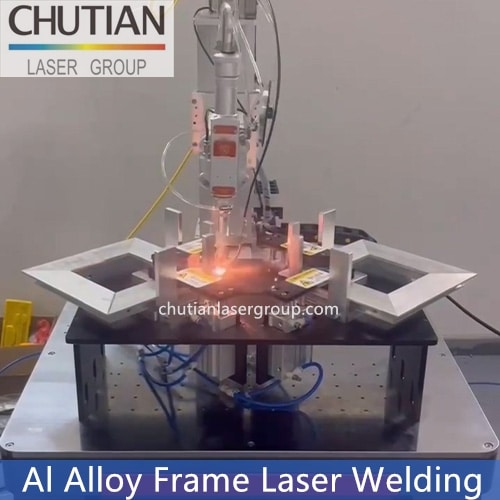
Automatic stations are intended for standardized, repeatable production:
Best for medium-volume runs of the same part.
Focus on consistent weld quality, reduced operator variability and high uptime.
Provide stable results with preset programs and industrial-grade components.
Robot Laser Welding Machines
Robot cells are the full-automation, high-precision solution:
Multi-axis motion for complex geometries and multi-position welding.
Designed for large volumes, high precision or hazardous environments.
Suitable for industries like automotive, aerospace and precision instruments.

Key component differences and what they mean for performance
Welding head and optics
Handheld: compact, minimal optics for portability — optimized for short duty cycles.
Automatic: industrial welding heads with improved heat dissipation — suitable for continuous operation.
Robot: highest-grade heads integrated with motion control for precise trajectory tracking.
Fiber core diameter & energy
Handheld units commonly use smaller core diameters (e.g., 25/50 µm) to generate high energy density for rapid melt — prioritizing penetration over cosmetic finish.
Automatic and robot systems favor larger core diameters (50–200 µm) for smoother energy distribution and less distortion during batch production; robot systems can dynamically adapt output along complex paths.
Cooling systems
Handheld: compact integrated chillers — portable but limited for sustained high-power usage.
Automatic: standalone industrial chillers to support long production runs.
Robot: intelligent, high-capacity cooling that can integrate with the cell controller for dynamic thermal management.
Match machine type to common scenarios
-
Handheld: small metal shops, on-site maintenance, prototype repair, low-volume custom jobs.
-
Automatic: component factories, appliance assembly, repeated bracket welding where consistency and throughput matter.
-
Robot: automotive body welding, aerospace parts, medical device sealing — where complex paths, many orientations or zero-tolerance are required.
Why choose Chutian Laser
With over 40 years of laser expertise and an installed base exceeding tens of thousands of units, Chutian Laser supports customers across all three categories — offering handheld units for flexible needs, industrial automatic machines for standardized production and robot-integrated solutions for high-precision manufacturing. Our service covers selection, on-site commissioning, operator training and lifecycle maintenance to ensure a smooth production ramp.
Buying checklist — five practical questions
What metals and maximum thickness will you weld?
What is your expected daily production volume (units/day)?
Do weld appearance and HAZ control matter for your product?
Is portability or on-site repair capability required?
Will you automate in the future (is robot/cobot compatibility desirable)?
Use these answers to pick handheld (low volume/portable), automatic (medium volume/standard parts) or robot (high volume/complex parts).
 Chinese