

Advanced QCW Laser Welding of Permalloy
A Comprehensive Analysis of Achieving 1E-9 atm-cc/sec Hermeticity and Aesthetic Excellence
Material Science Characteristics and Industrial Value of Permalloy
Permalloy, as an iron-nickel magnetic alloy with extremely high permeability and low coercivity, occupies an irreplaceable position in the field of modern precision manufacturing. Generally, the nickel content of Permalloy varies between 35% and 90%. By adjusting its chemical composition and heat treatment process, precise control of magnetic properties can be achieved. In industries such as electronic communication, precision measurement, aerospace, and microelectronics packaging, common Permalloy grades like 1J50, 1J79, and 1J85 are widely used to manufacture high-sensitivity transformers, electromagnetic shields, relay cores, and various precision sensors. These applications not only require materials with excellent soft magnetic properties but also often need to maintain long-term stability under harsh environments, which places extremely high demands on the joining process.
The magnetic properties of Permalloy originate from the specific alignment of its atomic magnetic moments, which is extremely sensitive to mechanical stress, residual deformation, and thermal history.1 Traditional arc welding or brazing often leads to significant deterioration of the soft magnetic properties in the weld and heat-affected zone (HAZ) due to excessive heat input or the introduction of chemical impurities, where the initial permeability may drop to 71% of the base metal or even lower.7 Furthermore, for electronic packages requiring high-vacuum environments or protection against external gas infiltration, airtightness is a key indicator of product quality. Achieving a leak rate of 1E-9 atm-cc/sec means the weld must achieve extremely high density, without any microscopic cracks or connected pores.
| Permalloy Grade | Nickel Content (Ni %) | Initial Permeability (μi) | Max Permeability (μm) | Saturation Magnetic Induction (Bs, T) | Applications |
|---|---|---|---|---|---|
| ASTM A753 Alloy 2 | 49.0 - 50.5 | ≥ 4,800 | ≥ 48,000 | ≥ 1.5 | High-frequency transformers, power relays |
| ASTM A753 Alloy 3 | 78.5 - 81.5 | ≥ 32,000 | ≥ 187,000 | ≥ 0.73 | Leakage protectors, current transformers |
| ASTM A753 Alloy 4 | 79.0 - 81.0 | ≥ 64,000 | ≥ 175,000 | ≥ 0.70 | Weak signal processing, high-precision sensors |
Technical Advantages and Principles of QCW Laser Welding
In the selection of welding processes for Permalloy, Quasi-Continuous Wave (QCW) fiber lasers demonstrate performance significantly superior to Continuous Wave (CW) lasers. By compressing pump energy, QCW lasers can output extremely high peak power in milliseconds, typically reaching more than 10 times the average power. This characteristic of “high peak power and low heat input” makes QCW lasers an ideal choice for processing ultra-thin, heat-sensitive, and high-reflectivity materials.
Continuous Wave (CW) laser welding, due to continuous energy input, produces a larger molten pool and a wide heat-affected zone, which in Permalloy leads to severe grain coarsening and subsequently increases hysteresis loss. In contrast, QCW lasers provide a critical “breathing time” between pulses, allowing the molten pool and its surrounding areas to dissipate heat rapidly, effectively limiting lateral heat conduction. This discrete energy transfer mode not only reduces the overall thermal deformation of the workpiece but also diminishes the impact of material surface reflectivity on welding stability, ensuring consistent penetration depth, which is the foundation for achieving high-hermeticity packaging.
| Feature | Continuous Wave (CW) Laser | Quasi-Continuous Wave (QCW) Laser | Impact on Permalloy Processing |
|---|---|---|---|
| Peak Power | Equal to average power | Up to 10x the average power | QCW easily penetrates surface oxide layers, increasing absorption. |
| Heat-Affected Zone (HAZ) | Wider | Extremely Narrow | QCW better preserves the soft magnetic structure of the material. |
| Pulse Energy | Constant and continuous | High single-pulse energy | QCW achieves extremely high instantaneous penetration depth. |
| Stability | Sensitive to reflections | Strong penetration capability | QCW performs more stably in precision hermetic packaging. |

Strategies for Crack and Porosity Control in Permalloy Welding
Since Permalloy has a single-phase face-centered cubic structure, its solidification characteristics during the welding process make it somewhat sensitive to hot cracking. When the liquid metal is subjected to strong tensile stress at the final stage of solidification, if the liquid film cannot fill the gaps between grain boundaries in time, microscopic solidification cracks will form. These micro-cracks are the primary culprits for failure in hermeticity testing (leak rates exceeding 1E-9)
To suppress cracking, the QCW laser pulse waveform must be optimized. The adoption of pulse shapes with a ramp-down sector has proven extremely effective. By linearly reducing the laser power at the end of the pulse, the solidification speed of the molten pool can be artificially delayed, giving the liquid metal sufficient time to flow back and fill the gaps between dendrites, thereby “healing” potential cracks. Additionally, increasing the duration of a single pulse and appropriately reducing the pulse frequency can decrease the cooling rate of the molten pool and alleviate phase transition stress.
Porosity control requires balancing laser power and welding speed. In QCW welding, the weld bead is formed by a series of overlapping spot welds, and the overlap rate directly affects hermeticity. For hermeticity requirements in the 1E-9 range, the overlap rate should generally be set between 75% and 90%. While an excessively high overlap rate ensures sealing, it leads to excessive heat accumulation and increases the risk of cracking; conversely, an insufficiently low overlap rate leads to discontinuous welds, forming penetrative leak channels.
Shielding Gas Selection and Enhancement of Weld Aesthetics
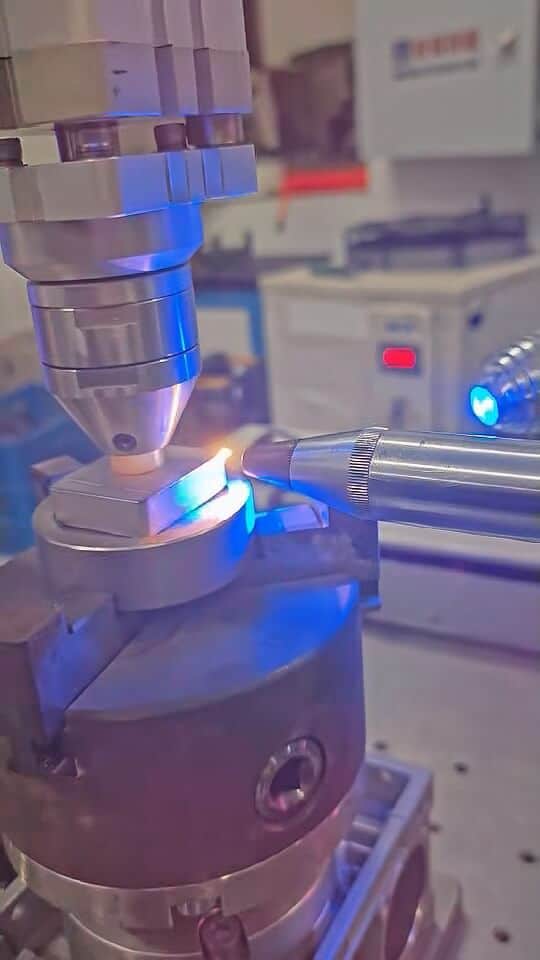
The aesthetic quality of the weld mainly depends on the degree of protection of the molten pool during the welding process to prevent blackening or roughness caused by oxidation. High-purity argon (purity ≥ 99.99%) is the most commonly used gas for welding Permalloy. Its high density allows it to cover the molten pool like a carpet, isolating oxygen and nitrogen from the atmosphere. In the QCW welding mode, the weld bead surface under argon protection usually presents a smooth and metallic luster “fish scale” characteristic.
However, for certain deep penetration requirements or applications extremely sensitive to porosity, adding helium to form a mixed gas (such as 75% Ar / 25% He) can significantly improve welding quality. Helium has a very high ionization energy (24.6 eV), which can effectively suppress the formation of plasma clouds, allowing laser energy to couple more directly into the interior of the material. The higher thermal conductivity of this mixed gas contributes to obtaining a more uniform weld structure, further enhancing the visual consistency and internal density of the weld.
| Gas Type | Ionization Energy (eV) | Thermal Conductivity (W/m·K) | Effect on Aesthetics | Contribution to Hermeticity |
|---|---|---|---|---|
| Pure Ar | 15.8 | 0.0177 | Smooth surface, bright and white color | Good coverage, reduces surface porosity |
| Pure He | 24.6 | 0.1513 | Narrower weld bead, may appear slightly rough | Strong penetration, suppresses plasma |
| Ar-He Mix | Intermediate Value | Intermediate Value | Combines cleanliness and uniformity | Optimal choice, significantly reduces microscopic leak rate |
In terms of flow rate control, it is generally recommended to maintain it between 15 and 25 L/min. An insufficiently low flow rate results in a gas layer that is too thin to withstand crosswind interference, leading to oxidative blackening; conversely, an excessively high flow rate triggers turbulence, drawing air into the molten pool and producing porosity instead. By using specialized nozzles with air curtain protection, the gas flow can be ensured to cover the welding area uniformly in a laminar manner, thereby achieving a mirror-like weld appearance.
Precision Control of Mechanical Fixturing and Assembly Gaps
As an autogenous process, laser welding has near-stringent requirements for assembly gaps. Since the focal diameter of a QCW laser beam is typically between 0.1 mm and 0.5 mm, any tiny gap will cause the laser beam to “shoot through” without producing effective metal bridging. For hermetic packaging, the accepted industrial guideline is that the assembly gap must not exceed 10% of the plate thickness or must be controlled within 0.1 mm.
In actual processes, we recommend adopting a stepped butt joint or a flanged fillet joint. The stepped structure provides a self-positioning shoulder, which greatly reduces the alignment accuracy requirement for the laser and increases the length of the sealing path. Furthermore, high-precision fixtures can not only eliminate gaps but also serve as “heat sinks” to absorb excess heat through their large thermal mass, thereby protecting the sensitive internal magnetic structures from damage due to overheating.
| Gas Type | Ionization Energy (eV) | Thermal Conductivity (W/m·K) | Effect on Aesthetics | Contribution to Hermeticity |
|---|---|---|---|---|
| Pure Ar | 15.8 | 0.0177 | Smooth surface, bright and white color | Good coverage, reduces surface porosity |
| Pure He | 24.6 | 0.1513 | Narrower weld bead, may appear slightly rough | Strong penetration, suppresses plasma |
| Ar-He Mix | Intermediate Value | Intermediate Value | Combines cleanliness and uniformity | Optimal choice, significantly reduces microscopic leak rate |
Conclusion: An Integrated Solution for Permalloy Welding
The successful implementation of high-quality laser welding for Permalloy is a systemic engineering task that must combine advanced laser equipment with a profound understanding of material science. By introducing laser cleaning technology, we can eliminate impurities at the source that cause surface blackening and porosity. Utilizing the high peak power and flexible pulse-shaping functions of QCW lasers, we can effectively suppress solidification cracks in high-nickel alloys and ensure the structural density of the weld.
Under the protection of high-purity argon-helium mixed gas, Permalloy welds can not only demonstrate excellent metallic luster but also pass the rigorous hermeticity test of 1E-9 atm-cc/sec. Finally, the indispensable two-step vacuum annealing process is the key closed-loop for restoring material magnetic properties and ensuring the final product meets functional standards. As experts in laser machine manufacturing, we are committed to providing customers with full-process technical support ranging from surface pretreatment and precision welding monitoring to magnetic recovery guidance, helping every Permalloy product reach its peak performance.
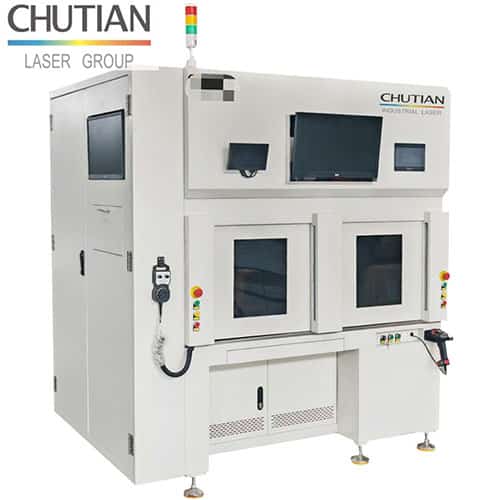
Our CNC Laser Welding Machines are designed for high-precision, high-efficiency, and fully automated welding solutions. Whether you’re dealing with complex geometries, thin sheet metals, or demanding production lines, our customizable CNC systems deliver unmatched welding accuracy and repeatability.
Key Features
- Fully Customizable Design
- High-Precision CNC Control
- Multi-Material Compatibility
- Global Service & Support
 Chinese